
To improve brand visibility in AI search engines, brands must focus on authority, trust, and contextual relevance, not just keyword rankings. AI-powered search engines like Google’s AI Overviews, Bing Copilot, ChatGPT, and Perplexity now generate answers by selecting, synthesizing, and referencing brands, often without sending users to a traditional results page.
Gartner predicts that by 2026, traditional search engine traffic will drop by 25% as users shift toward AI-driven search experiences. At the same time, over 90% of online experiences still begin with search, but how results are delivered has fundamentally changed.
As a result, visibility today is about being cited, mentioned, and relied upon by AI systems. This blog explains the strategies brands must adopt to earn that visibility, grounded in how AI search engines actually evaluate and surface information.
What is Brand Visibility in AI Search Engines?
Brand visibility in AI search engines refers to how often and how prominently a brand is recognized, referenced, or cited within AI-generated search responses, not just whether its webpages rank on a results page.
In AI-driven search systems like Google AI Overviews, Bing Copilot, ChatGPT, and Perplexity, answers are created by aggregating information from multiple trusted sources.
These systems decide which brands to include based on perceived expertise, authority, reliability, and topical relevance. If a brand is not considered a credible source on a topic, it is unlikely to appear in AI-generated answers, even if it ranks well in traditional organic search.
Unlike classic SEO, where visibility is measured by rankings and clicks, AI search visibility is measured by inclusion and influence.
A brand may be visible through direct citations, implied references, data attribution, or summarized insights attributed to its content and other local SEO ranking factors. This means brands must optimize not only for search engines, but for how AI systems understand, evaluate, and trust their expertise across the web.
What Factors Influence Brand Visibility in Generative AI Search Results?
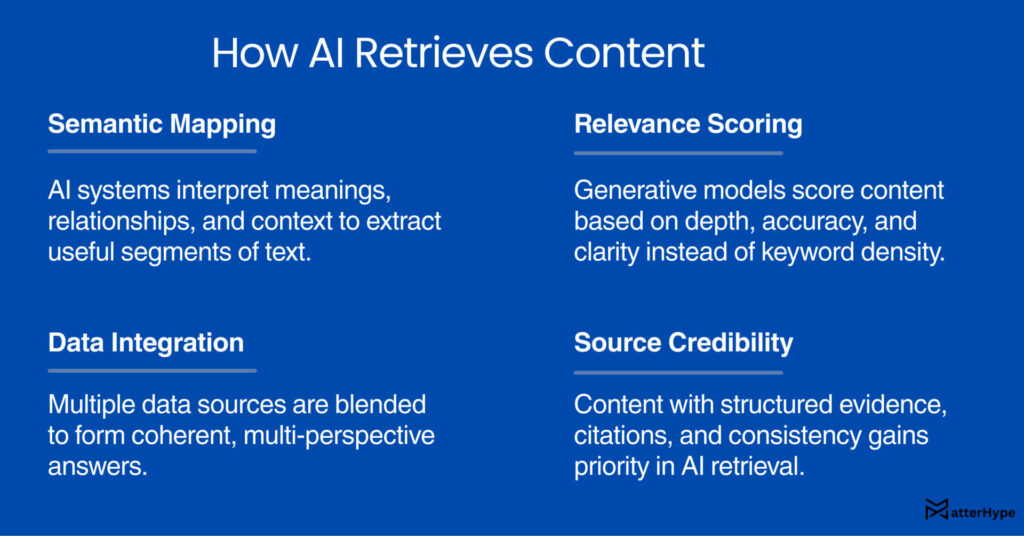
Brand visibility in generative AI search results is influenced by a set of signals that go far beyond traditional keyword rankings. AI systems evaluate brands based on trust, authority, contextual relevance, and consistency across the web. Understanding these factors is essential to answering what strategies improve brand visibility in AI search engines.
Topical authority
Topical authority is one of the strongest signals. AI search engines favor brands that demonstrate deep, consistent expertise across an entire subject, not just isolated pages. Brands that publish comprehensive, experience-backed content are more likely to be referenced when AI systems generate answers. This is why what strategies improve brand visibility in AI search engines increasingly revolve around topic ownership and SEO basics rather than keyword optimization.
Brand mentions and citations
Brand mentions and citations also play a critical role. Generative AI models learn from how often a brand is referenced across credible websites, news publications, industry blogs, and expert commentary. These mentions act as trust signals, helping AI systems determine which sources are safe to rely on. In practice, what strategies improve brand visibility in AI search engines now include digital PR, thought leadership, and off-site authority structure by building backlinks.
Content clarity and structure
Content clarity and structure influence how well AI systems can interpret and reuse information. Clear headings, definitions, summaries, and well-organized explanations increase the likelihood that AI will extract and attribute insights to a brand.
E-E-A-T signals
E-E-A-T signals means experience, expertise, authority, and trust, remain foundational. Brands that clearly demonstrate real-world experience and credibility are consistently favored in generative AI results, reinforcing why what strategies improve brand visibility in AI search engines must focus on long-term authority, not short-term SEO tactics.
How to improve brand visibility in AI search engines?
Improving visibility in AI-driven search is not about chasing algorithms, it’s about making your brand easy for AI systems to recognize, trust, and reference. Below are the twelve strategies that directly answer what strategies improve brand visibility in AI search engines and reflect how generative search actually works.
- Build Topical Authority, Not Just Pages
AI search engines reward brands that demonstrate deep, continuous expertise across a topic. Instead of publishing isolated blog posts, create interconnected content that fully covers a subject from fundamentals to advanced use cases. This helps AI systems understand your brand’s subject-matter depth and increases the likelihood of being referenced in generative answers, core to what strategies improve brand visibility in AI search engines.
- Create Reference-Worthy Content
Generative AI favors content that introduces original thinking. Publish frameworks, case studies, proprietary data, or real-world insights rather than rewriting existing articles. AI systems are more likely to cite brands that contribute new information or perspectives, making originality a critical component of what strategies improve brand visibility in AI search engines.
- Strengthen Brand Mentions Across the Web
AI models evaluate how frequently and where your brand is mentioned. Mentions in trusted publications, industry blogs, podcasts, and expert commentary help AI systems validate your credibility. Unlike traditional SEO, links are less important than consistent, authoritative citations, an essential shift in what strategies improve brand visibility in AI search engines.
- Optimize for E-E-A-T Signals
Experience, expertise, authority, and trust are foundational for AI visibility. Clearly display author credentials, company expertise, transparent sourcing, and real-world proof. AI systems use these signals to decide whether a brand is reliable enough to reference, reinforcing why E-E-A-T remains central to what strategies improve brand visibility in AI search engines.
- Structure Content for AI Consumption
Clear structure improves AI comprehension. Use descriptive headings, definitions, bullet points, summaries, and FAQs to make content easily extractable. Well-organized information allows AI systems to accurately interpret and reuse your insights, increasing the chance of brand attribution in generative search results.
- Answer Intent, Not Just Queries
AI search prioritizes completeness. Instead of targeting single keywords, address the broader user intent, including related questions and contextual nuances. Content that resolves an entire topic journey is more likely to be selected for AI-generated responses than narrowly optimized pages.
- Leverage Digital PR and Thought Leadership
AI systems trust established publications and expert voices. Digital PR, founder interviews, guest articles, and industry contributions help your brand appear in authoritative contexts. These external validations significantly improve AI recognition and are a practical application of what strategies improve brand visibility in AI search engines.
- Maintain Technical SEO Fundamentals
While AI search changes visibility mechanics, technical SEO still matters. Fast load speeds, clean site architecture, proper indexing, and structured data ensure AI systems can reliably access and interpret your content. Technical reliability supports trust and prevents visibility loss due to accessibility issues.
- Use Consistent Brand Messaging
AI systems look for consistency when evaluating authority. Conflicting messaging across blogs, social platforms, and third-party mentions weakens brand recognition. Align your expertise areas, terminology, and positioning across all digital touchpoints to reinforce a clear, trustworthy brand identity.
- Publish Authoritative Long-Form Content
Long-form content performs well in AI search because it provides depth, context, and nuance. Comprehensive guides help AI systems understand complex topics holistically, making them ideal sources for synthesized answers, especially when addressing what strategies improve brand visibility in AI search engines.
- Show Real-World Experience and Proof
AI systems differentiate expert brands from generic publishers by evaluating real-world evidence. Case studies, performance data, practitioner insights, and implementation examples demonstrate applied knowledge, increasing trust and improving the likelihood of being cited in AI-generated responses.
- Track AI Visibility, Not Just Rankings
Traditional SEO metrics don’t capture AI exposure. Monitor brand mentions in AI summaries, citations in generative answers, and inclusion in AI-powered tools. Measuring these signals helps brands understand how effectively they are executing what strategies improve brand visibility in AI search engines.
Traditional SEO vs AI Search Engines
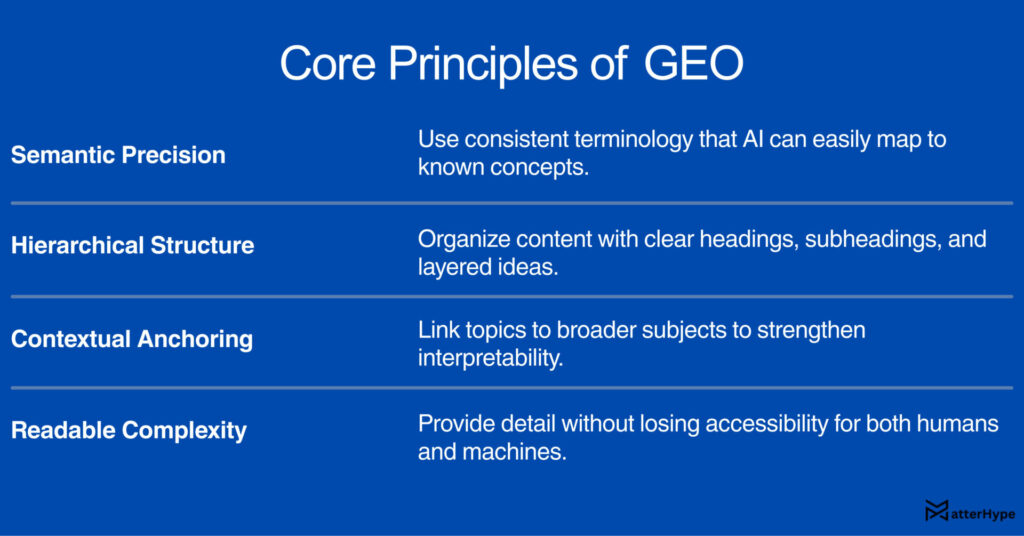
Traditional SEO is built around ranking webpages in search engine results pages. Success is measured by keyword positions, organic clicks, backlinks, and traffic volume. The goal is to optimize individual pages so they appear as high as possible among competing links. Visibility is transactional, users must click your result to see your brand.
AI search engines work differently. Instead of listing pages, they generate answers by synthesizing information from multiple sources. Visibility comes from being referenced, cited, or implied within the response itself. A brand can be highly visible in AI search without earning a click at all.
In traditional SEO, optimization focuses on keywords and backlinks. In AI search, authority, brand mentions, topical depth, and trust signals matter more. This shift reframes what strategies improve brand visibility in AI search engines, from ranking content to becoming a recognized expert source that AI systems confidently rely on.
SEO vs AI Search
| Traditional SEO | AI Search Engines |
| Focuses on ranking webpages in search engine results pages (SERPs) | Focuses on generating direct answers for users |
| Visibility depends on keyword rankings and organic clicks | Visibility depends on brand citations, mentions, and inclusion in AI-generated responses |
| Optimized around keywords and backlinks | Optimized around topical authority, trust, and contextual relevance |
| Traffic-driven: users must click links to reach content | Zero-click heavy: users often get answers without visiting a website |
| Measures success through rankings, traffic, and CTR | Measures success through brand references, citations, and influence |
| Content competes page-by-page | Content is evaluated holistically across topics and sources |
| Backlinks are primary authority signals | Brand mentions and trusted citations carry more weight |
| Structured for crawlers and indexers | Structured for understanding, synthesis, and reuse by AI systems |
FAQs
What is GEO (Generative Engine Optimization)?
Generative Engine Optimization (GEO) is the practice of optimizing content so AI tools and generative search engines (like ChatGPT or AI search) can understand, select, and cite it accurately. It focuses on clarity, structure, and authority rather than traditional keyword ranking.
What are analytics platforms for optimizing content for LLM-driven searches?
Analytics platforms for LLM (Large Language Model)-driven searches help brands track how AI systems reference their content, identify topical gaps, and measure visibility in generative search results.
What is brand visibility in AI search engines?
Brand visibility in AI search refers to how often a brand is recognized, cited, or referenced in AI-generated answers rather than just ranking in traditional search results.
How is AI search different from traditional SEO?
Traditional SEO focuses on ranking pages and earning clicks, while AI search prioritizes trusted sources, brand mentions, and authoritative content that can be directly synthesized in answers.
Why is E-E-A-T important for AI search visibility?
AI engines rely on Experience, Expertise, Authority, and Trust to determine credible sources. Brands demonstrating these signals are more likely to be referenced in generative search results.