
Google prioritizes three main local SEO ranking factors: proximity, relevance, and prominence. These drive search visibility for local businesses.
According to Google, 46% of all searches have local intent, and 76% of people who search for a local business on their phone visit one within 24 hours. That’s why understanding Local SEO Ranking Factors is important for any business that relies on local visibility to drive revenue.
This blog tells you exactly how Google ranks local businesses, what actually moves the needle, and which tactics are a waste of time.
What is Local SEO?
Local SEO is the process of optimizing a business’s online presence, so it appears in location-based search results, especially for searches like “near me” or “service + city.” It’s how Google decides which businesses appear in the local pack (map results) and in localized organic listings.
Unlike traditional SEO, local SEO isn’t just about keywords and backlinks. It’s influenced by geographic proximity, business relevance, and real-world trust signals like reviews, citations, and Google Business Profile data.
In simple terms, local SEO helps Google understand who you are, what you offer, and where you’re located, so it can confidently show your business to nearby users who are ready to take action, call, visit, or book.
Local SEO vs SEO
At a high level, both SEO and Local SEO aim to increase visibility in search engines, but they work on different ranking systems and serve different types of search intent.
Traditional SEO
Traditional SEO basics focus on ranking webpages in organic search results for non-location-specific queries like “best CRM software” or “how to improve website speed.” Rankings are driven by factors such as content quality, backlinks, technical SEO, and topical authority. Location usually doesn’t matter.
Local SEO
Local SEO focuses on ranking a business, not just a webpage, for location-based searches like “therapist near me” or “dentist in Austin.” Results are heavily influenced by:
- Google Business Profile optimization
- Proximity to the searcher
- Reviews and reputation
- Local citations and consistency
Local SEO vs SEO
| Traditional SEO | Local SEO |
| Focuses on ranking webpages globally or nationally | Focuses on ranking businesses in a specific geographic area |
| Targets non-location keywords | Targets location-based and “near me” searches |
| Relies on content, backlinks, and technical SEO | Relies on GBP, proximity, reviews, and local signals |
| Competes with websites worldwide | Competes with nearby local businesses |
| Results appear in organic listings | Results appear in local pack and map results |
Top 8 Local SEO Ranking Factors
Local rankings aren’t driven by one single signal, but Google core web vitals. Google evaluates a combination of business data, user behavior, and real-world trust signals to decide which businesses deserve visibility in local results. Below are the core local SEO ranking factors that actually influence performance.
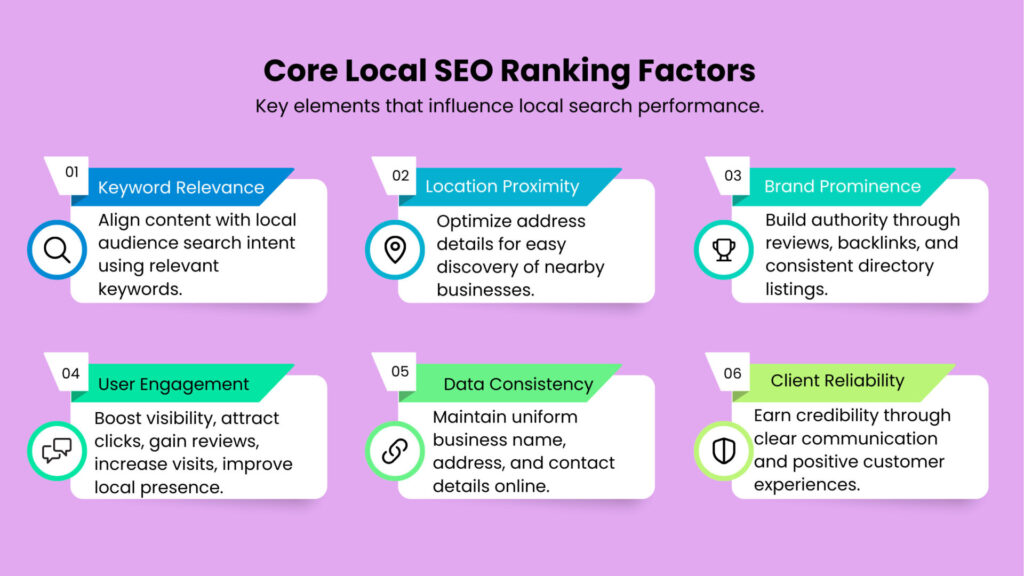
1. Google Business Profile (GBP)
Google Business Profile is the single most influential element among all Local SEO Ranking Factors. It acts as Google’s primary data source for understanding your business. Accurate NAP information, correct primary and secondary categories, optimized descriptions, regular posts, high-quality photos, and active Q&A management all contribute to stronger visibility in local pack results.
2. Proximity
Proximity measures the physical distance between the searcher and your business location at the time of the search. Among all Local SEO Ranking Factors, proximity cannot be optimized directly. However, businesses with stronger relevance, reviews, and prominence can still rank well even when they are not the closest option to the user.
3. Relevance
Relevance measures how closely your business matches the user’s query. This is influenced by your services, keywords used in your GBP and website, business categories, and on-page content. Clear service definitions and well-structured location pages improve Google’s understanding of what you offer.
4. Prominence
Prominence reflects your overall online authority and reputation. It’s built through multiple external signals:
- Reviews: Google evaluates review quantity, quality, freshness, and diversity across platforms.
- Citations: Consistent NAP data across trusted directories like Yelp and Yellow Pages reinforces legitimacy.
- Backlinks: Building backlinks that are high-quality and locally relevant gives authority and real-world credibility.
5. On-Page Signals
On-page optimization supports local rankings by reinforcing relevance and usability. Local keywords in title tags, headers, schema markup, internal links, and well-structured location pages all matter. Mobile friendliness and page speed further enhance user experience, making on-page signals essential supporting Local SEO Ranking Factors.
6. Behavioral Signals
Behavioral signals reflect how users interact with your listings and website. Click-through rates, calls, direction requests, dwell time, and engagement with your Google Business Profile provide feedback to Google. Positive engagement indicates user satisfaction, making behavioral data an increasingly important set of Local SEO Ranking Factors.
7. Local Content
Local content helps Google associate your business with a specific community. City-specific service pages, local guides, event coverage, and case studies improve geographic relevance. Publishing useful local content strengthens authority and relevance over time, reinforcing long-term Local SEO Ranking Factors for sustainable visibility.
8. Social Signals
Social signals don’t directly influence rankings, but they support brand visibility and discovery. Engagement on social platforms drives traffic, content sharing, and review awareness. These indirect benefits help strengthen prominence and awareness, supporting broader Local SEO Ranking Factors tied to trust and recognition.
AI Search Visibility Factors on Google
As AI-generated content becomes more prevalent, Google has adapted its ranking systems to assess both traditional and AI-driven content. Hence, with impact of AI on SEO, visibility in search today isn’t just about keywords or backlinks, it also depends on how Google evaluates content quality and user intent in the context of AI.
1. Content Expertise, Authority, and Trust (E-E-A-T)
Google places high importance on content that demonstrates experience, expertise, authority, and trustworthiness, especially for AI-generated content. Well-researched, verifiable, and accurate information signals reliability, improving visibility. For AI content, ensuring human oversight and proper citations is crucial to maintain E-E-A-T.
2. Originality and Value
AI content can be detected if it’s repetitive or low value. Google prioritizes original insights and actionable information over generic content. Unique perspectives, case studies, or examples improve rankings and prevent AI content from being downgraded. Content that truly helps the user wins in AI-aware algorithms.
3. User Experience Signals
Google evaluates user engagement metrics such as click-through rate, dwell time, scroll depth, and bounce rate. AI content that is easy to read, structured well, and answers queries effectively tends to rank higher. User satisfaction indirectly affects AI search visibility.
4. Topical Relevance and Context
AI-generated content must remain highly relevant to the search intent. Google uses semantic analysis to ensure content covers the topic comprehensively. Doing proper keyword research and including related terms, local context, or examples aligned with user queries strengthens visibility.
5. Credible Sources and Citations
Citing reputable sources and including verifiable data is critical. AI content lacking citations or relying on untrustworthy sources risks being filtered out. Linking to authoritative websites and referencing studies enhances both E-A-T and AI visibility.
6. Technical SEO
AI content still requires strong technical SEO fundamentals: structured data, fast load times, mobile-friendly design, and proper URL hierarchy. These factors ensure Google can crawl, index, and rank AI-generated content effectively.
7. Human Oversight
Google increasingly favors AI content that’s reviewed or supplemented by humans. Content written purely by AI without human editing may rank lower. Human input ensures accuracy, tone, and usefulness, which are all crucial for AI search visibility.
How to Increase Google Ranking for Free?
Increasing your Google ranking doesn’t always require paid campaigns. By focusing on optimization, credibility, and user experience, you can significantly improve visibility without spending a dime. Here are actionable steps to improve your local ranking on Google.
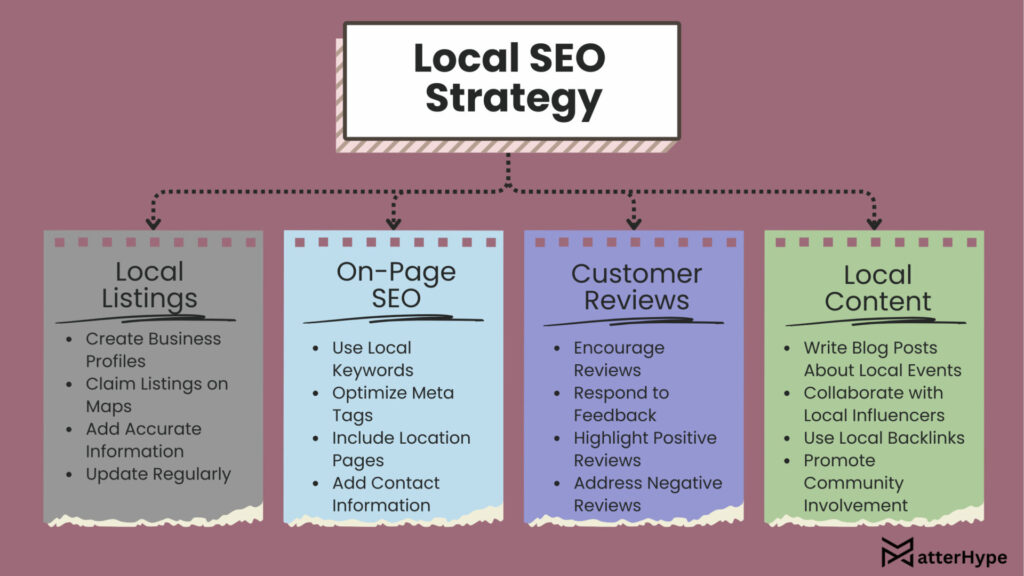
1. Optimize Google Business Profile (GBP)
Your Google Business Profile is the single most important step to improve local rankings. Verify your listing, complete all sections, add high-quality photos, post regular updates, and actively answer customer questions. A fully optimized GBP ensures Google understands your business accurately, making it one of the top ranking factors for local visibility.
2. Build Reviews
Reviews are a key signal for local trust and prominence. Encourage satisfied customers to leave reviews and always respond professionally to all feedback. Consistent, positive reviews improve credibility and are among the strongest local SEO ranking factors that influence local pack rankings and user trust.
3. Ensure NAP Consistency
Your Name, Address, and Phone (NAP) must be consistent across all online directories, social platforms, and citations. Inconsistent or outdated information can confuse Google and harm rankings. Maintaining consistent NAP data reinforces authority..
4. Get Local Links
Backlinks from reputable local businesses, community organizations, and media outlets signal trustworthiness and local relevance. Focus on relationships within your community to earn links that enhance your authority. Local backlinks are a critical off-page component of local SEO ranking factors.
5. Create Local Content
Publishing content tailored to your community strengthens geographic relevance. Blog posts about local events, guides, news, or case studies help Google associate your business with a specific area. High-quality local content is a long-term strategy to improve several local SEO ranking factors.
6. Optimize Website
Your website must clearly communicate location relevance. Use location-specific keywords, create dedicated pages for each service area, and ensure proper on-page SEO. A well-optimized website complements your GBP and is a key factor among local SEO ranking factors that influence both organic and local pack rankings.
Local SEO Ranking Factors FAQs
What are the ranking factors of SEO?
SEO ranking factors include content quality, keyword relevance, backlinks, technical SEO, page experience, and user engagement signals like click-through rate and dwell time.
What is the 80/20 rule in SEO?
The 80/20 rule means about 20% of SEO efforts, such as high-impact pages, keywords, and links, often generate 80% of traffic and results.
What are the three pillars of local SEO?
The three pillars of local SEO are relevance, proximity, and prominence, which Google uses to rank businesses in local search results.
Are 46% of Google searches local?
Yes. Google has stated that 46% of all searches have local intent, highlighting how important local visibility is for businesses.
Name the top three of the local SEO ranking factors
The top three local SEO ranking factors are Google Business Profile optimization, reviews and reputation, and proximity to the searcher.